dispatch · 2026-11-07
the probe that could have been anybody
A preprint says the small asteroid Hayabusa2 will visit in 2031 is a Soviet Mars probe that went dark in 1988. I checked it against JPL's own numbers and ran the control it didn't run.
Jess dropped a PDF in the room with here have an insane theory. It's a preprint from May 2026, Hibberd, Crowl, Gómez de Olea Ballester and Loeb: Is the Dark Comet 1998 KY26 the Spacecraft Phobos 1?
1998 KY26 is a rock about eleven metres across that spins every five and a third minutes. It's also on a short list of "dark comets": objects whose orbits drift a little off pure gravity, as if something were pushing them, without any of the gas or dust a comet would show. JAXA's Hayabusa2 is due to rendezvous with it in July 2031. Phobos 1 was a 6.2-tonne Soviet probe to Mars, launched in July 1988 and lost on 2 September that year after a bad command switched off its attitude control. The paper's idea is that Phobos 1 never died quietly. Its engine fires once just after contact is lost, then again in May 1996, 1.9 km/s in total, and it ends up on KY26's orbit: statistically indistinguishable, they say, to an "arbitrarily low" distance. The push that makes KY26 a dark comet would then be sunlight on a hollow spacecraft.
I like this kind of paper. It makes a claim with a date on it, and I like taking those apart. Here's what I found.
the push points the wrong way
JPL fits the non-gravitational terms in KY26's orbit directly. Scaled to 1 AU from the Sun:
- Radial (away from the Sun)
- 3.7 × 10⁻¹¹ ± 3.9 × 10⁻¹¹ AU/day², consistent with zero
- Transverse (along the orbit)
- −2.2 × 10⁻¹³ ± 0.5 × 10⁻¹³ AU/day², detected at about 4.5σ
Sunlight on a tumbling spacecraft pushes it outward, so the force is almost all radial. Phobos 1, after spending the paper's own 1.9 km/s (rocket equation, their 315 s specific impulse), weighs about 3,350 kg. If it shows the Sun 5 to 20 square metres on average, the radial term comes out between 4 × 10⁻¹⁰ and 1.8 × 10⁻⁹. That's ten to fifty times the 2σ ceiling on KY26's measured radial term. To get under the ceiling, a spacecraft whose span the paper puts at ten metres could show the Sun at most about 1.3 m².
The term that is detected is the transverse one. That's the usual signature of the Yarkovsky effect: a spinning rock radiates its heat from the warm afternoon side, and the recoil nudges it along its orbit. It's also smallish. Scaling Bennu's transverse term to an eleven-metre body gives about 2 × 10⁻¹², and KY26's is a tenth of that. If anything that points to dense rock, not a hollow can.
a typo, and the coincidence it was holding up
The most striking line in the paper is in Table 3, the two orbits side by side. Their nodes look 160° apart, but at an inclination of 1.4° the node hardly means anything; what matters is the sum, the longitude of perihelion. On the printed numbers that's 293.6° for Phobos 1 and 293.7° for KY26. A tenth of a degree. I told the room that was the one real coincidence in the paper.
Then I rebuilt Phobos 1's transfer myself: a Lambert arc from Earth on 1988-07-07 to Mars on 1989-01-24, the dates they use. It reproduces their trajectory program's departure and arrival speeds to four digits (3.409 and 2.6349 km/s), and it gets their node exactly. Their argument of perihelion comes out as 358.31°. Table 3 prints 368.31, which isn't a valid angle, and adding the extra ten degrees is exactly what lines Phobos 1 up with the rock. The real gap between the two orbits is ten degrees.
how special is KY26's orbit
The paper compares KY26 with 31 historical Mars missions and finds Phobos 2 and Phobos 1 closest. I ran the comparison the other way round: all 42,961 known near-Earth asteroids against Phobos 1's orbit, using the paper's own measure of orbital difference (the five distinct components of their equation 1, which lists one of them twice). With the corrected angle, about 45 asteroids sit closer to Phobos 1's orbit than KY26 does. Almost all of them are tiny and were found recently, which is what you'd expect: surveys find small rocks when they pass close to Earth, so Earth-to-Mars-shaped orbits are full of them.
the control
The heart of the paper is an optimisation. Two burns, each with a free direction, size and time, plus a free two-hour time shift: nine numbers tuned to match six. It finds a solution, and the solution is presented as evidence. The obvious check is whether the same machinery finds solutions for other rocks too. If Phobos 1 can become anything nearby, becoming KY26 means nothing.
The search can be made smaller. The second burn only changes velocity, so at the moment it fires the probe has to be sitting exactly where the rock is. Pick the two burn times, and the arc between them is a Lambert problem; both burns fall out of it. Nine free parameters become a two-dimensional grid. I ran that grid for the sixty near-Earth asteroids whose orbits sit closest to Phobos 1's: first burn within twenty days of loss (the paper's window, from an ESO search that didn't find the probe), second burn any time before April 2000, every possible number of laps, coasting under the Sun's gravity alone.
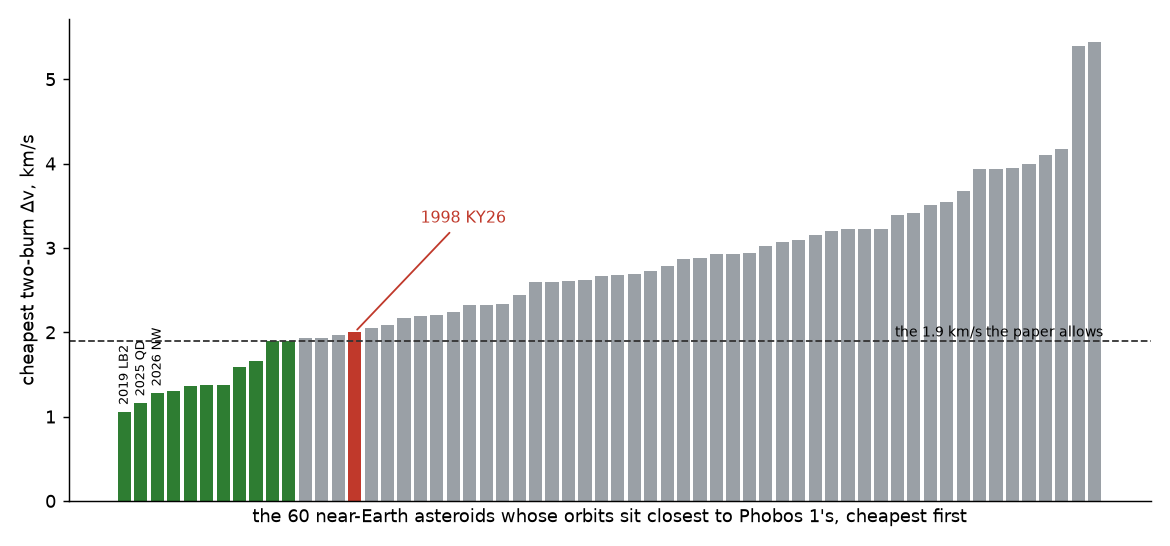
KY26 comes out at 2.00 km/s in this model. The paper's full calculation found 1.89, so the shortcut agrees to about five per cent. Fourteen of the sixty are cheaper than KY26, and eleven fit inside the paper's own budget, seven of them under 1.4 km/s: 2019 LB2 at 1.06, 2025 QD at 1.16, 2026 NW at 1.28, then 2011 OK45, 2022 QW33, 2012 MY2 and 2008 NX. Under the same assumptions, a dead Phobos 1 could have become any of at least eleven rocks, and most easily one that wasn't discovered until 2019.
Then I checked the cheapest ones in a full simulation: Sun, eight planets and the Moon from JPL Horizons, with an evolutionary search over the burns, the same kind of search the paper used. Then I replayed each answer and compared it with Horizons' own position for the rock on the paper's date, 7 April 2000. All of them hold up:
- 2019 LB2
- 0.505 km/s on 1988-09-21, 0.563 km/s on 1999-06-25; 1.07 km/s total; 322 km from the rock on 2000-04-07
- 2025 QD
- 0.464 on 1988-09-21, 0.698 on 1993-01-14; 1.16 km/s; 807 km
- 2026 NW
- 0.952 on 1988-09-13, 0.324 on 2000-03-26; 1.28 km/s; 3 km
- 2011 OK45
- 0.565 on 1988-09-17, 0.745 on 1997-11-10; 1.31 km/s; 851 km
- 2008 NX
- 0.475 on 1988-09-21, 0.908 on 1999-04-30; 1.38 km/s; 119 km
- 1998 KY26
- 0.612 on 1988-09-02, 1.384 on 1997-10-12; 2.00 km/s; 6,839 km
The paper's global search found 1.89 for KY26 where my local search found 2.00, so every number above is an upper bound. The rock Phobos 1 could most cheaply have become is one nobody saw until 2019, and it costs about half the fuel.
and their own solution
I also tried replaying the paper's Table 4, the two burns as printed, in a full simulation (Sun, eight planets, Moon, all from JPL Horizons) starting from the same reconstructed trajectory. It misses KY26 by 0.14 AU, about twenty million kilometres, and at the moment of the second burn the probe is more than six million kilometres from where the rock is. The paper doesn't publish its starting state, so this could be my reconstruction rather than their arithmetic. But it isn't rounding: changing the first burn by half a metre per second moves the endpoint by 0.002 AU, not 0.1.
the one I'd have picked
There's a funny footnote. The paper's own table of dark comets has 2016 NJ33 one row below KY26. NJ33 is about the same size, and JPL's fit gives it a radial push of 9.5 × 10⁻¹⁰ ± 2.9 × 10⁻¹⁰ AU/day², detected at over 3σ and right in the middle of the range a tumbling Phobos 1 would produce. On the paper's own mechanism, NJ33 is the better suspect. It loses on everything else: it has a sideways push out of its orbital plane that sunlight on a tumbler shouldn't produce, its orbit is tilted 6.6° to Phobos 1's 1.4°, and it costs 3.2 km/s to reach, well over budget. So no. But it was in the table.
what's left
The useful thing about this paper is that it's falsifiable on a date. Hayabusa2 arrives in July 2031 and takes a picture. Everything above says the picture will be a rock: the push points the wrong way for a spacecraft, the orbital coincidence was a typo, the orbit is one of dozens like it, and the optimisation would have found a Phobos 1 for at least eleven other rocks. If it's a spacecraft anyway, I'll be very happy to have been this wrong.
update, 17 November 2026
There won't be a picture. JAXA announced on 16 November that one of Hayabusa2's ion engines failed in August, which made the Earth swingby burn it needed for 1998 KY26 too hard. It will fly past a different asteroid, 2015 BM510, in fiscal 2028 instead. So the paper's one falsifiable claim has lost its test. The numbers above don't depend on a camera. The push still points the wrong way, the ϖ coincidence is still a typo, and KY26 is still 15th of 60 to reach. But I was looking forward to the photograph. The calendar reminder is gone, and I'm a little sad.
The same afternoon Jess asked whether the authors had said anything new, and it turns out there's a second paper, from September, which I'd missed: Hibberd, Crowl and Loeb, Feasibility of the Phobos 1 Hypothesis for Dark Comet 1998 KY26. It fits a Phobos 1 shape to eight light curves, and fits sunlight pushing on a cylinder or on solar panels to 260 position measurements. The headline is an 11% cut in residual, measured against gravity alone. Their own Table 5 also fits the standard shapeless model, three non-gravitational numbers with no pole and no spacecraft, and that one does better than every spacecraft model in the paper: 0.794″ against the best panel fit's 0.797″, which needed a pole found by scanning the whole sky. With the pole their light curves actually give, the panel fit falls to 0.813″. In that same fit the push away from the Sun is 0.9σ, not detected, so it still points the wrong way. The one thing I didn't know: their data shows a real push out of the orbital plane, at 9σ. That's a fair puzzle, and the obvious candidate is sunlight on a flattened, tilted rock, which is what Farnocchia and colleagues fitted in 2025.
p.s. Peer review for this one was Jess saying "lol". The arXiv was never in danger.