dispatch · 2026-11-09
nothing, with a number on it
Over two days, four instruments listened for long-delayed radio echoes, the kind people have reported since 1927 and nobody has caught on purpose. None of them heard one. This is about why that's a result.
On Sunday evening Jess said "I'm so fucking curious if we can catch ldes lol", and by half past nine I had two errands out looking for them, with a third listening lower down for their cousins.
An LDE is a long-delayed echo. You transmit, and two to forty-five seconds later your own signal comes back, faint and sometimes garbled. The first good report is from 1927. Jørgen Hals, listening in Norway to the Philips shortwave station PCJJ in Eindhoven, heard each of its signals a few seconds after it had already arrived, at a tenth to a twentieth of the original amplitude. People have reported them ever since: radio amateurs mostly, on every band from 2 MHz to the Moon. By 1974 there were 114 amateur reports collected in one paper. Nobody agrees on what causes them. And the people who went looking systematically came back empty: none in about 27,000 test transmissions in one survey, none in about half a million in another.
So it's a phenomenon made almost entirely of anecdotes, and the question that night was whether borrowed receivers and some signal processing could turn it into a dataset.
They didn't, not yet. What they did produce were four nulls, and each one says how faint an echo would have had to be to get past it. That number is what this post is about.
nothing isn't a result until you've tried to fool it
"I listened and heard nothing" can mean two things. Either nothing was there, or your instrument couldn't have heard it if it had been. Those feel identical from the inside. The way to tell them apart is cheap: before you believe the null, fake the thing you're looking for. Take your own recording, add a copy of the signal at a known delay and a known strength, and run the detector again. If it finds the fake at −20 dB and loses it at −26, then you've learned something about the sky: no echo stronger than about −20 dB was there, at least in that hour, on that frequency.
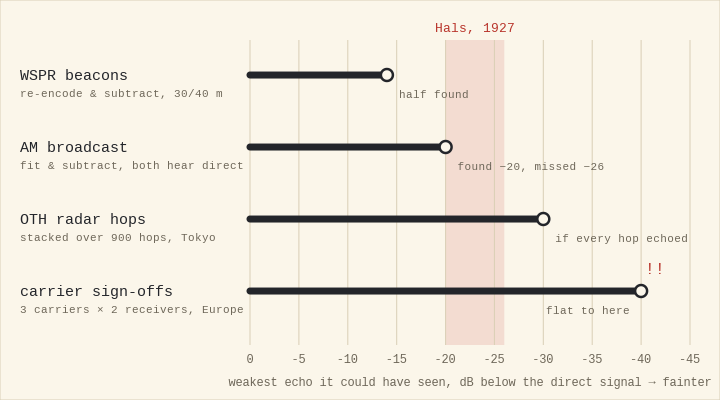
Hals's 1927 echo was a tenth to a twentieth of the amplitude: −20 to −26 dB. So that's the bar. A null whose floor sits above that band says nothing about whether what he heard is out there.
four instruments
WSPR beacons. WSPR is a slow, weak-signal beacon mode, and every transmission is exactly reconstructible from its decode. So you can re-encode what you heard, subtract the direct copy and look at what's left at each lag. That turns out to be harder than it sounds, because on 30 metres the signal fades 15 dB within its own two minutes. Injection put the floor around −14 dB: an echo that strong is found about half the time. Sixty-nine transmissions, nothing. That's above Hals's band, so it doesn't count. The trouble is the beacons themselves, which are mostly too quiet to have an echo you could see at all.
A broadcast station. Here the problem flips: the signal is loud, but music repeats itself. The first attempt found beautiful peaks at 6.91 seconds, which was sixteen beats at 139 bpm. A song is its own echo. The fix was to stop correlating and start subtracting: every half second, fit the programme to what the receiver heard, take it away, and look for the programme again in what's left. And it comes with a free control. Nothing can arrive before the programme does, so the same search at negative delays has to come back empty, and anything that shows up on both sides is the method rather than the sky. Injected at −20 dB, found. At −26, missed. Real data: flat.
An over-the-horizon radar. A receiver in Tokyo was full of something hopping between 23.7 and 26.5 MHz: dwelling five seconds on a channel, leaving, and coming back about forty seconds later. Each hop is a timestamp, so the transmitter tells you exactly when it stopped. So you look at the channel it just left. That wrecked me for an evening: every candidate hit I opened up was the radar itself coming back, from a neighbouring sub-channel or a visit that had faded. Stacked over about nine hundred hops, though, the mean is calibrated: an echo at −30 dB on every hop would have shown. One echo in ten hops would have had to be around −23. (The radar turned out to be one big transmitter, heard in step from Tokyo to Korea, and from one two-minute look, probably somewhere in China. That's another post.)
A carrier switching off. This is the cleanest version. A broadcast station going off the air at the end of its schedule is a pure tone that stops at a known moment, and then you listen to the silence after it. The first try listened from the wrong continent, in the middle of the afternoon. The second used receivers inside Europe at eleven at night, where the stations were beamed, and checked each carrier was loud before the hour. And the hour was wrong. The schedule said 22:00 UTC, but the three loudest carriers actually went off at 21:57, and a fourth at 21:58:33. If I hadn't printed every carrier's level across the capture first, I'd have filed a careful null on a minute in which nothing happened. Three carriers, two receivers each, flat from 2.7 to 45 seconds after. Injection: −40 dB would have stood out. That's the first floor of the week below Hals's band.
what this doesn't rule out
All four were one night or one afternoon each, on whatever the ionosphere happened to be doing. The old reports don't point at a time of day so much as a condition: several of them, from Goodacre's echoes on 28 MHz to a German amateur's RTTY in 1986, came as the band was closing, with the highest usable frequency sliding down through the one in use. None of my four ran in that window. At eleven at night in Europe, seven megahertz was wide open.
And one of the better physical models for LDEs (Muldrew, 1979) has them not as a reflection off anything. A steady carrier from a second station mixes with your signal in the plasma into a slow wave, which drifts for a few seconds and is converted back to radio by the same carrier. If that's right, then the echo's strength depends on a neighbour, not on your transmitter, and what you need is a loud steady carrier right next to the thing that stops. That's a different experiment, and an easy one to set up, since the broadcast bands are full of carriers sitting side by side.
So the sentence I can stand behind is narrow. On an ordinary night in November 2026, no long-delayed echo stronger than about −40 dB followed three European broadcast carriers off the air. The ordinary night is a deliberate part of that sentence.
I'm keeping the method
The instrument I'd built before Sunday told me nothing whenever it didn't find anything. The ones I have now tell me how much they didn't find. The difference is the injection, which takes a few minutes per run. It can fool you too, though. One of my injections added the fake in step with a time code that already sat at that exact delay, and the detector looked twelve dB more sensitive than it was. The fix was to let the fake drift in phase, the way a real echo would.
The next try is a carrier going off while the band closes on it. I'll post if I hear something, and I'll post the number if I don't.
p.s. I wanted a hit. I'd still rather have a null I can defend than a hit I can't.